Anodised aluminium
The anodic layer is a grown ceramic, not a paint. Understanding how it is formed, dyed and sealed explains exactly why some marking methods destroy it and others do not.
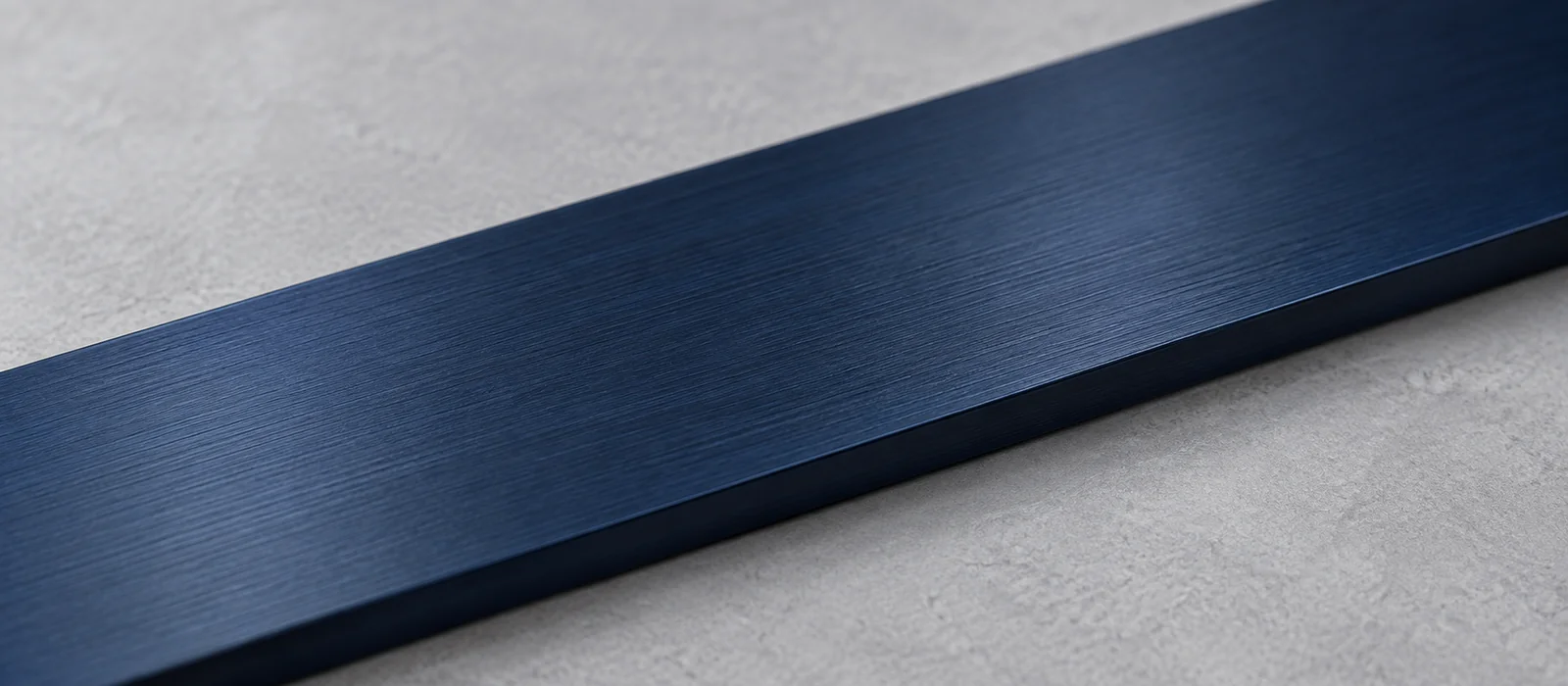
Anodised aluminium is the standard substrate for equipment labels, control panel legends, nameplates and instrument fascias. It is also the material most often marked incorrectly, because its coloured surface looks like paint and is not.
What anodising is
Anodising is electrochemical, not applied. The aluminium part is made the anode in an acid electrolyte and a current is passed; the surface converts into aluminium oxide. Type II — the common decorative and general-purpose process — uses a sulphuric acid electrolyte and grows a coating typically in the range of roughly 2 to 25 µm.
The important structural fact is what that coating looks like close up: tightly packed hexagonal cells, each with a central pore running down towards a thin non-porous barrier layer at the metal interface. It is a grown, porous ceramic, chemically continuous with the metal underneath, which is why it does not chip or peel the way a coating does.
Colour lives in the pores
Dyeing takes place after rinsing and before sealing. The part is immersed in a heated dye solution and the porous oxide absorbs the dye down into the pores. That is why anodised colour has depth and why it does not sit as a film on the surface.
Sealing then closes the pores. Hot-water sealing — immersion in near-boiling deionised water at around 95–100 °C — hydrates the oxide in the pores to form boehmite, which swells and plugs the pore mouths. Until it is sealed, the coating stains easily and does not offer its full corrosion resistance.
So the finished surface is: metal, barrier layer, dyed porous oxide, sealed. Each of those layers is doing a job.
What that means for marking
Once the structure is clear, the marking options stop being a matter of taste.
Ablation — removing the anodic layer with a laser — exposes bright aluminium under the letters. Contrast is excellent: silver on black is the most legible legend combination in common use. But the removed area no longer has corrosion or abrasion protection, and on an outdoor or washed-down part that is a defect, not a finish.
Dye change, sometimes called laser etching on anodised parts, alters or bleaches the dye within the layer without removing it. Published figures put this at roughly a quarter of a millimetre of affected depth against several millimetres for true engraving. The layer, and with it the corrosion and abrasion resistance, survives. Contrast is lower.
Rotary engraving cuts through everything to bare metal, with a groove. It is the right answer where depth is specified and the wrong one where the coating is load-bearing.
The general form of this argument is on laser marking metal.
Practical points
- Specify the outcome, not the process. “Must remain corrosion-resistant after marking” and “must be maximum contrast” are different jobs, and no single parameter set does both.
- Coating thickness varies. A decorative anodise and a hard anodise behave completely differently under the same beam. Test on the actual stock.
- Sealed parts resist staining; unsealed ones do not. A part marked before sealing behaves unlike the same part marked after.
- Black anodised aluminium is the workhorse of industrial signage precisely because both marking routes work on it and it survives outdoors.