Engraving laminate and Traffolyte
A two-layer plastic sheet where the colour of the letters is already inside the material. Cutting through the cap layer is the whole technique, and it is why control panel legends are quick.
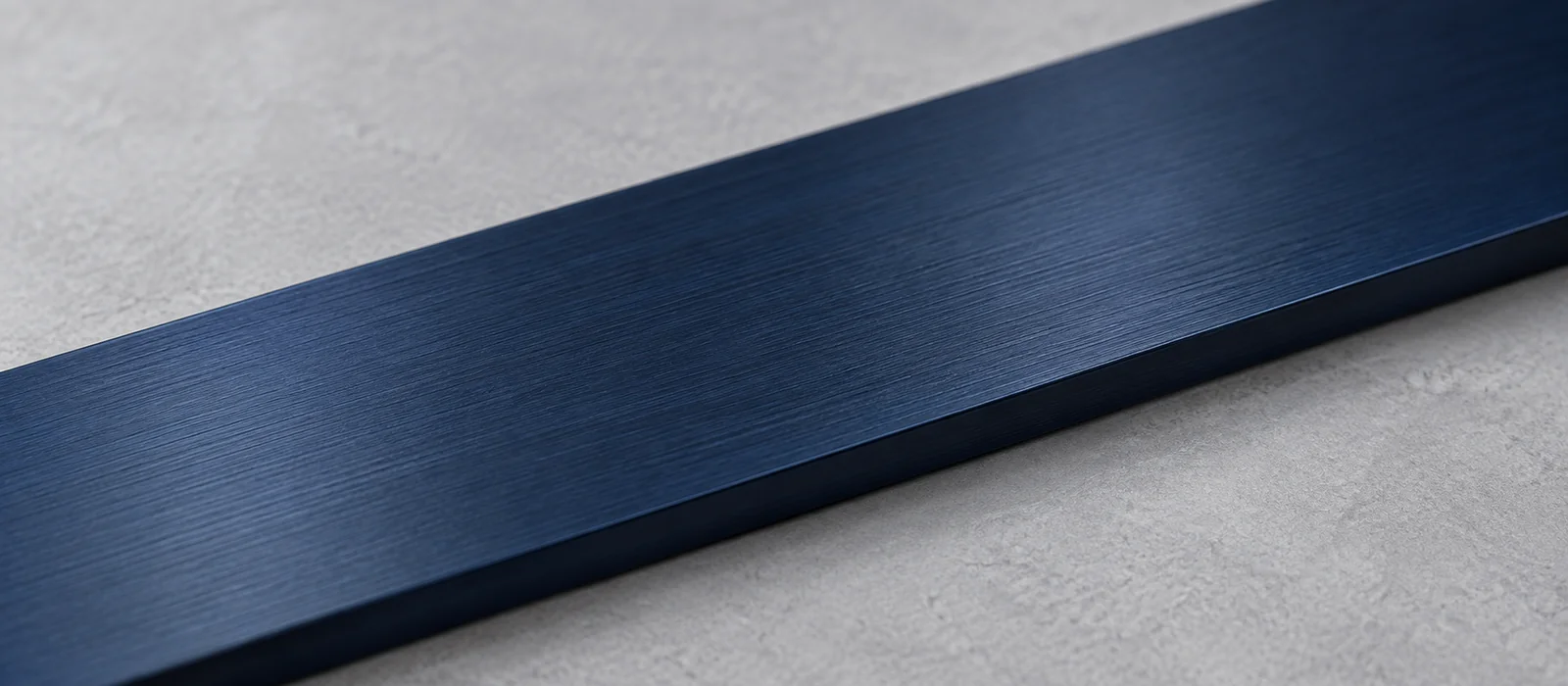
Engraving laminate is the least glamorous material in the trade and probably the most used. It is a rigid plastic sheet made in two or three bonded layers: a thin coloured cap over a core of a contrasting colour. Cut through the cap and the core shows. That is the entire principle.
In Britain the hard phenolic version has been known generically by the trade name Traffolyte for so long that the name is used for the whole material class, in the same way as Formica or Perspex.
Why it exists
Everything about the material is arranged so a legend can be made quickly and repeatably.
- The colour is structural. There is no ink and no paint, so nothing to fade, chip or wash off. The letters are a hole in the top layer.
- The depth is self-limiting. The cutter needs to reach the core and no further, so depth setting is a one-off calibration for a given sheet, not a per-job decision.
- The contrast is fixed at manufacture. White-on-black, black-on-white, white-on-red, yellow-on-black — standard combinations, consistent between batches, which matters when a plate made today has to match one made five years ago.
- It cuts cleanly. Rigid, dimensionally stable and machinable, so edges do not fray and small text stays sharp.
Rotary is the natural process
This is rotary engraving’s home ground. A spinning cutter removes the cap and produces a groove of the cutter’s own width and profile; a diamond drag is useless here because it displaces material rather than removing the cap.
Laser also works on many laminates, and for volume it is faster, but the two produce visibly different edges: a cutter gives a mechanically clean wall, a laser gives a slightly melted one. On fine text side by side, the difference is noticeable.
Where it is used
Almost everywhere something needs identifying rather than admiring: control panel legends, switchgear and distribution board labels, valve and asset tags, door and locker plates, machine warning plates, laboratory and plant labelling.
A large slice of that is pipe and services identification. BS 1710 is the British Standard for identifying pipelines and services, and it works through colour-coded bands, content names and flow-direction arrows — the recognised way of meeting the pipe-marking expectations that sit under the safety signs regulations. Engraved laminate tags are one of the standard carriers for that information, because they survive plant environments and can be tied or screwed to a pipe without adhesive. More on that in industrial signage.
Practical points
- Phenolic and acrylic laminates are not the same. The traditional phenolic type is hard, heat-resistant and chemically tough; acrylic-based laminates are lighter and cheaper and less happy in heat.
- UV is the outdoor limit. Indoor and plant use is where laminate belongs. Outdoors, prolonged sunlight fades the cap and embrittles the sheet, and a metal or stone plate is the more honest choice.
- Thin caps are unforgiving. A shallow cut leaves ghosting; a deep cut widens the letter and closes up the counters in small type.
- Text size has a floor set by cutter width, which is the standing constraint of the whole rotary process.