Engraved glass and glassware
Wheel engraving, diamond point, acid etching, blasting and cameo work — five ways of cutting glass, what each one looks like, and how to tell them apart on a finished piece.
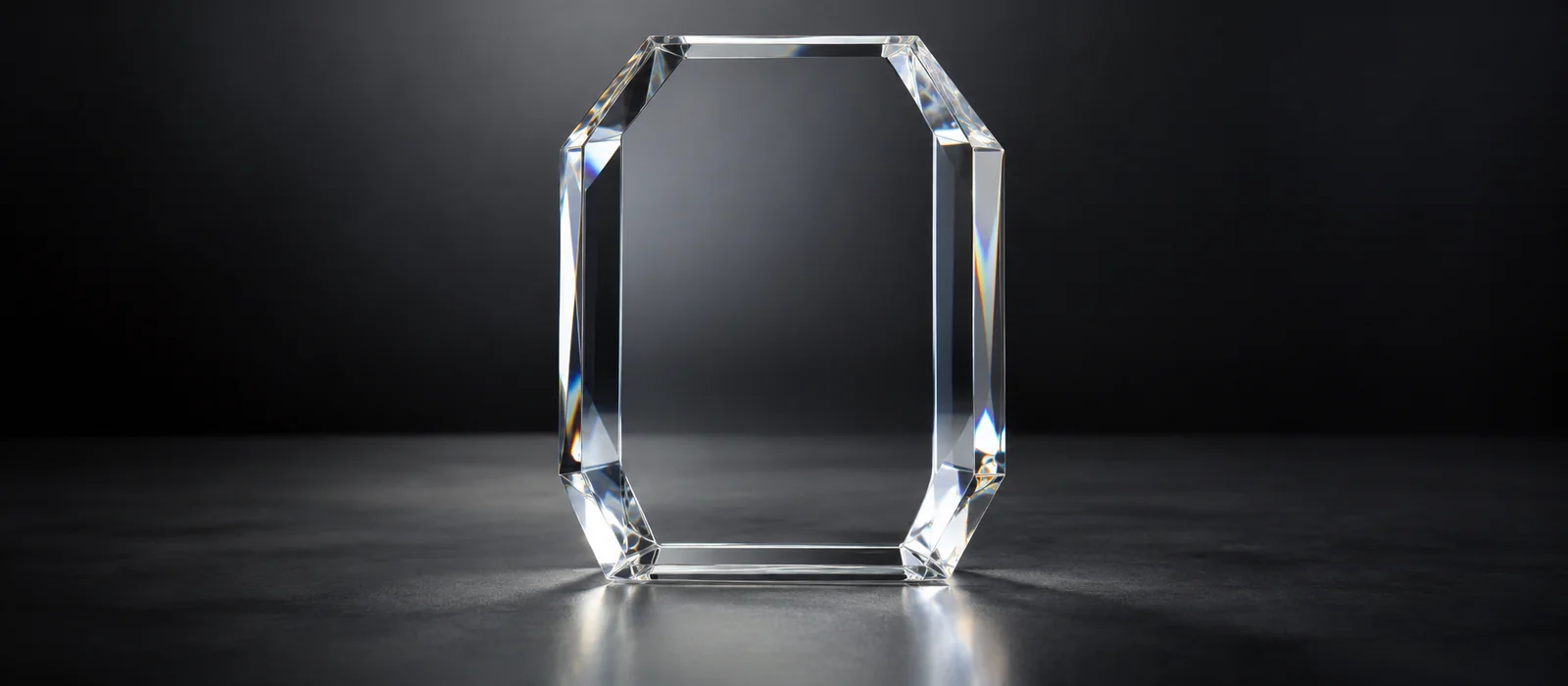
Glass is brittle and transparent, and both facts shape how it is decorated. You cannot cut a chip out of it the way you cut metal; you fracture the surface in a controlled way, and the fractured area scatters light. That scattering is the mark. Everything below is a different method of producing it.
All of this belongs to coldworking — shaping and decorating glass after it has been formed and annealed, at room temperature, as distinct from anything done at the furnace.
Wheel engraving
The classic method, and the one that produces the most modelled results. A rapidly spinning wheel is fed with an abrasive and pressed against the glass, cutting away at the surface. Wheels come in a range of diameters, thicknesses and edge profiles, so the engraver changes wheel to change the cut, much as a hand engraver changes graver.
Traditionally the wheels are copper, charged with an abrasive suspended in oil. Because the wheel is a fixed shape and the glass is moved against it, the work happens blind, from the far side — which is why wheel engraving has always been the most demanding of the glass techniques.
Diamond point
Scratching lines into the surface with a diamond. It is the simplest technique and it produces a distinctive fine, linear, silvery drawing. It began in Venice in the early 1500s and had entered the repertoire of English glass decorators by the end of that century.
Because a diamond point needs no wheel, no acid and no compressor, it is also the technique most associated with amateur and commemorative work — a piece inscribed for an occasion, in a hand that is identifiably a hand.
Acid etching
A chemical process using hydrofluoric acid, alone or with sulphuric acid, to dissolve glass from the surface. Varying the glass type, acid strength, exposure time and process gives finishes ranging from smooth through textured to frosted.
It produces a very even, uniform matte that is difficult to reach by mechanical means. It is also the reason acid etching is not a small-shop technique: hydrofluoric acid is severely hazardous.
Abrasive blasting
Erosion through a resist, described in full on the sandblasting glass page. It is the only glass technique that gets to real depth quickly, and the one that scales from a light surface frost to sculptural carving. It carries a serious respirable-dust hazard, and the guidance is linked there.
Cameo glass
Not a marking technique but a construction. Layers of differently coloured glass are fused, and the decoration is carved or etched down through the upper layer to reveal the layer beneath — typically opaque white figures standing on a dark ground. The technique first appears in Roman art of around 30 BC and was revived in the nineteenth century. It is the ancestor of every two-layer contrast material, including the modern engraving laminate sheet.
Telling them apart
| Look | Likely process |
|---|---|
| Deep, softly modelled, polished highlights | Wheel engraving |
| Fine silvery scratched line, slightly irregular | Diamond point |
| Even matte area, no depth, crisp edge | Acid etching |
| White frost with visible depth and a hard resist edge | Abrasive blasting |
| White figures raised over a coloured ground | Cameo glass |
| Shallow grey-white frost, faint dot structure | Laser |
A practical note on glassware
Thin, curved and stemmed pieces are the awkward cases. Curvature defeats a flat laser bed unless the piece is rotated; thin walls limit blasting depth; and thermal shock is a live risk on anything laser-marked, because a laser mark on glass is a field of micro-fractures. Heavy straight-sided pieces are the forgiving ones, which is why they dominate presentation work.