Slate and stone
Slate is a metamorphic rock that splits into flat sheets and shrugs off weather. That combination is why it has carried outdoor lettering in Britain for centuries.
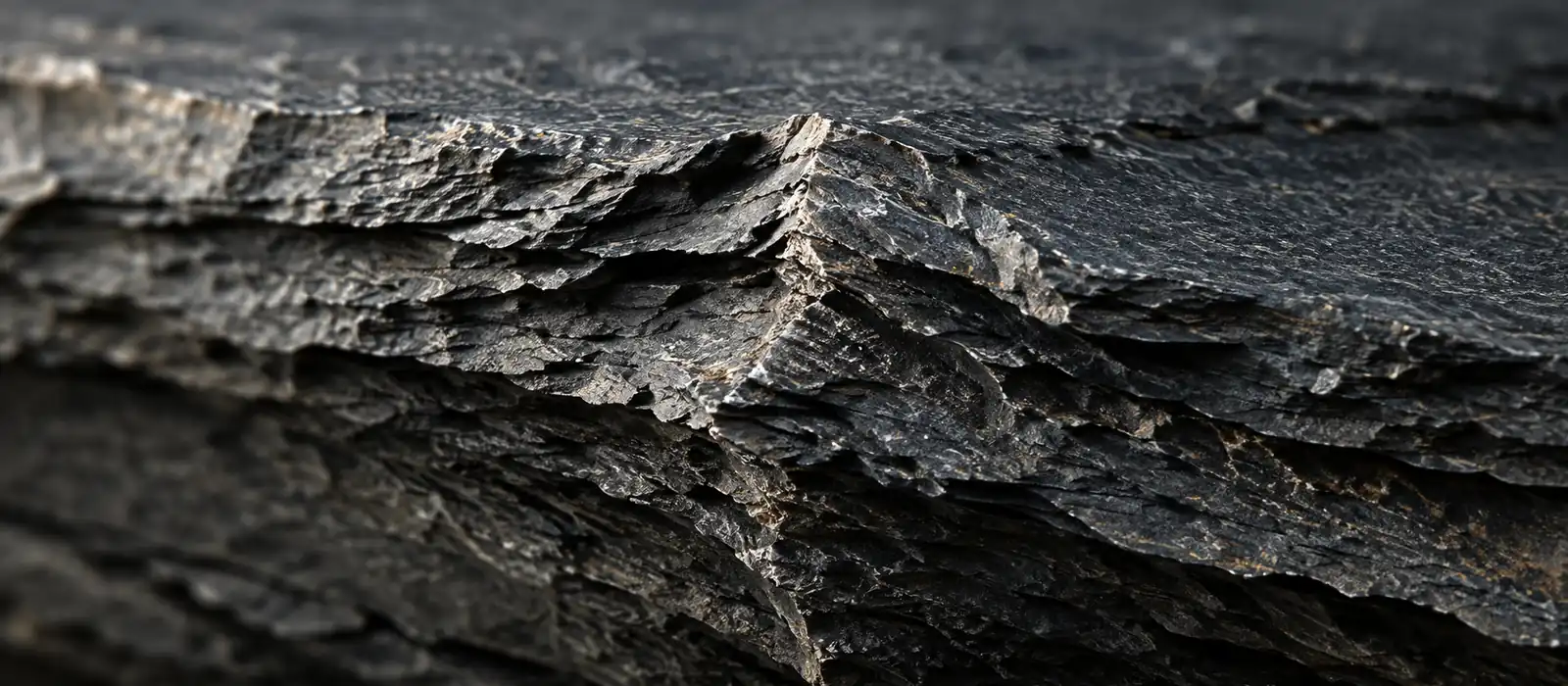
Slate is the default British outdoor lettering material, and its dominance is not sentimental. It is a consequence of how the rock formed.
Why slate behaves the way it does
Slate is a metamorphic rock — mudstone compressed and heated over geological time until it recrystallised. Two properties come out of that history.
It cleaves into flat sheets. The slaty cleavage runs perpendicular to the direction of compression, so the rock splits naturally into thin, broad, flat plates. You do not have to saw a slab out of it; the material arrives in roughly the shape a sign wants.
It is dense and effectively non-absorbent. That density is what makes it resistant to frost damage, since frost damage in stone is water getting in, freezing and expanding. Slate is described as waterproof in practice, unaffected by normal temperature extremes, and non-fading under sustained sunlight.
Welsh slate, quarried in north Wales, is characteristically blue-black, and pyrite and quartz are commonly present in it. Different quarries give different colours and different amounts of mineral speckling, which is why two slate signs from different sources do not match.
Finishes, and what they do to legibility
The face finish matters more than the material grade for a sign that has to be read from a road.
- Riven — the natural cleaved face. Uneven, textured, most obviously “stone”. Beautiful, and the least legible, because the texture competes with the letterform and casts its own shadows.
- Honed — ground flat with a matte finish. The compromise most house signs settle on: flat enough for crisp letters, matte enough not to glare.
- Polished — flat and reflective. Darkest and highest contrast against painted letters, but it throws sun and headlight glare straight back, which can make a sign unreadable at exactly the moment someone is looking for it.
Slate is dark, so contrast normally comes from filling the cut with a light paint or gilding. The letters are engraved or blasted to give the paint a recess to sit in, and the recess is what makes the fill last — paint applied to a flat surface weathers off, paint in a groove is sheltered.
Compared with the alternatives
| Material | Strength | Weakness |
|---|---|---|
| Slate | Weather, frost and UV resistance; traditional appearance | Heavy; brittle at edges; dark, so needs a fill |
| Acrylic | Light, cheap, easy colour choice | Yellows and crazes with prolonged UV |
| Cast metal | Very long-lived, high status | Cost; corrosion depends entirely on the alloy |
| Timber | Warm appearance | Needs a maintenance regime and will not survive neglect |
Practical points
- Maintenance is a wash. Soap and water is generally enough. Aggressive cleaners and pressure washing attack the paint fill long before they touch the stone.
- Fixings are the failure point, not the slate. Stone outlives its screws. Stainless fixings and a small gap for drainage behind the plate matter more than the stone specification.
- Edges chip. Slate is hard but brittle; the damage on an old sign is almost always at a corner or a fixing hole.
- Legibility rules still apply. Material choice does not exempt a sign from being readable from the street, which is the subject of the house nameplates page.