Stainless steel
Stainless is not stainless by composition alone — it is protected by a self-healing passive film. Cutting through that film is the central question in every marking decision.
Stainless steel is the material where the difference between a mark in the surface and a mark through it is not aesthetic. It is a corrosion engineering decision.
The passive layer
The corrosion resistance of stainless steel comes from a thin, chromium-rich oxide film that forms spontaneously on the surface when chromium in the alloy reacts with oxygen in the air. The film is invisible, adherent and only nanometres thick, and it is the entire mechanism — the bulk metal underneath would rust perfectly well without it.
Its most useful property is that it is self-healing. Scratch it and the exposed chromium re-oxidises and rebuilds the film. Published work on scratched AISI 304 and 316 puts the reconstruction time at roughly two hours for both grades.
That regeneration is real but conditional. It needs oxygen. A deep, narrow groove that traps moisture, chlorides or process residue is a place where oxygen does not reach easily and the film does not fully rebuild — and that is precisely the geometry an engraved letter has.
304 and 316
Two grades cover most of what an engraver sees.
304 is the general-purpose austenitic grade. Its weakness is chlorides: in coastal air, marine settings or chloride-bearing process environments the passive layer can break down locally, producing pitting.
316 is the standard molybdenum-bearing variant. The molybdenum improves resistance to pitting and crevice corrosion in chloride environments specifically.
The practical rule: coastal, marine, swimming pool, food-processing and washdown environments are 316 environments, and a 304 plate installed in one will pit around the lettering first, because the lettering is where the crevices are.
Marking, in order of surface disruption
| Process | Material removed | Passive layer | Typical use |
|---|---|---|---|
| Annealing | None | Intact | Medical, food contact, hygiene |
| Etching / shallow ablation | Very thin surface | Locally disturbed | General identification |
| Deep engraving | Measurable depth | Broken; needs repassivation | Wear-exposed asset marking |
| Diamond drag | Displaced, not removed | Locally disturbed | Fine bright lettering |
Annealing heats the surface to grow a dark oxide without removing material, leaving the corrosion-resistant passive layer intact — that is its entire reason for existing. The mark is flat, dark and cleanable, and it can be polished off, which is the trade.
Deep engraving is for marks that must survive abrasion. It leaves a groove, and on stainless that groove is a crevice. Where a part goes into a corrosive service, repassivation after engraving is the step people skip and then blame on the steel.
Bare stainless does not absorb far-infrared usefully, so this is fibre-laser work; a CO₂ machine cannot mark it without a marking compound. That argument is on the laser marking metal page.
Practical points
- Ask about the environment before the finish. Indoors and dry, almost anything works. Chloride-bearing and wet, the process choice narrows to annealing or a properly repassivated engraving.
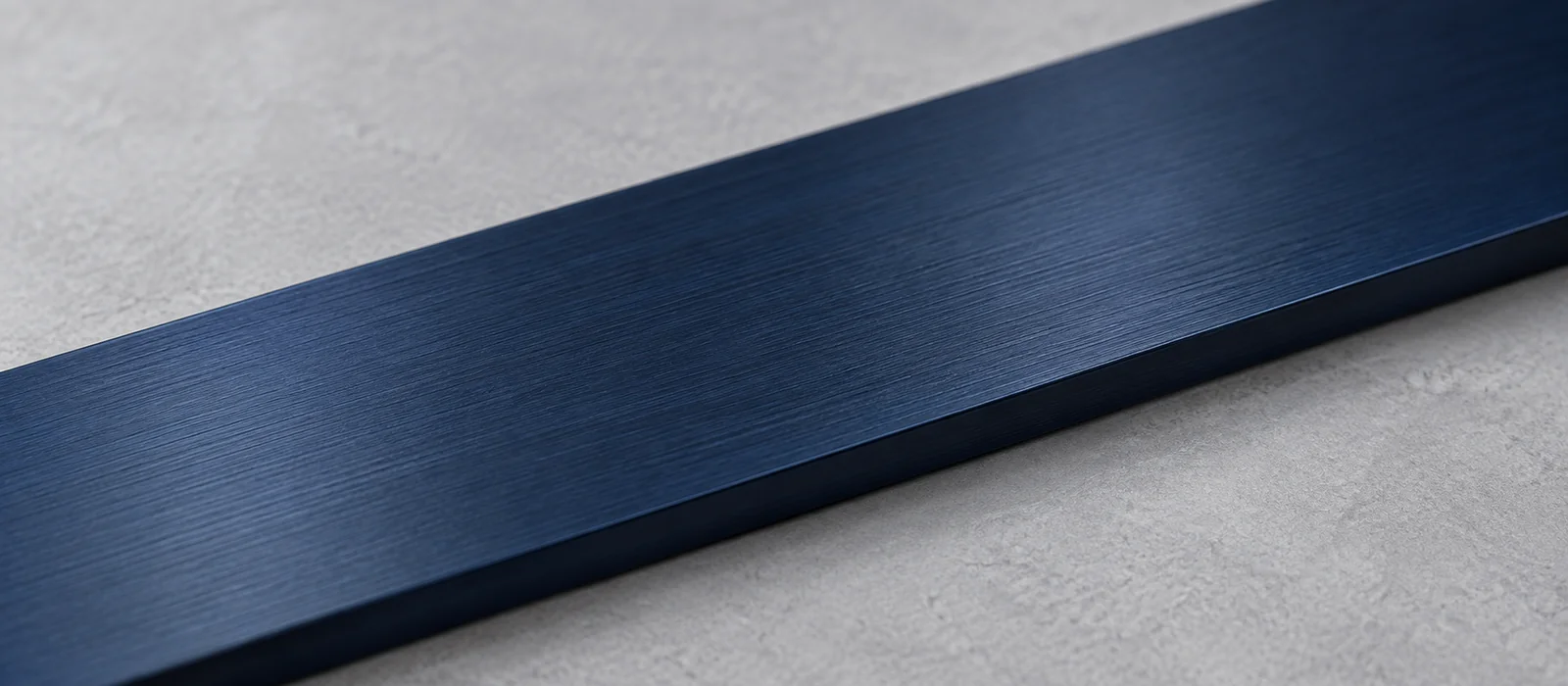
- Brushed finishes hide shallow marks. A directional grain scatters light and reduces the apparent contrast of an annealed mark, especially when the grain runs along the stroke.
- Cheap “stainless” plaques are often plated or 200-series. They behave differently and can rust conspicuously outdoors.