Awards, trophies and presentation pieces
Optical crystal, silver, pewter and glass, and the sub-surface laser process that puts a three-dimensional image inside a block without touching its surface.
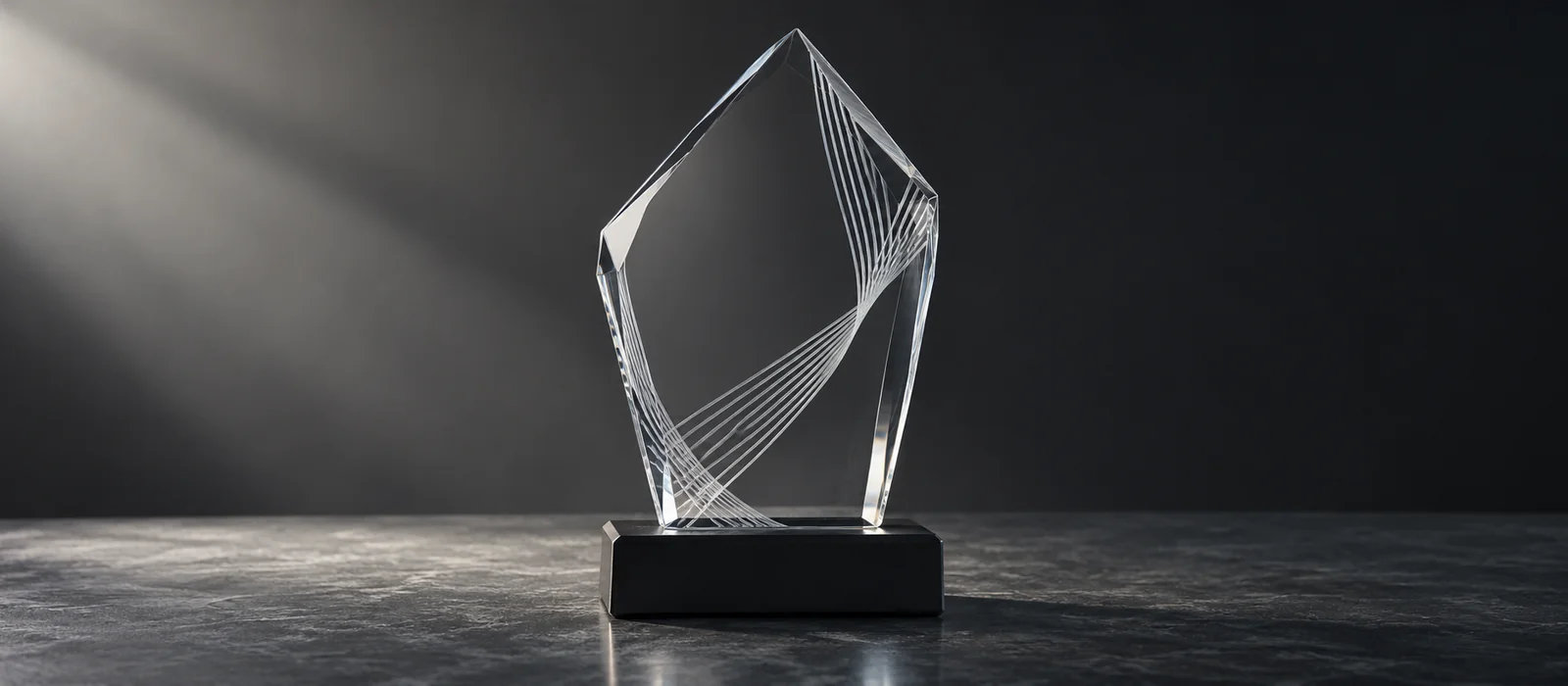
An award is an object whose entire function is to be kept and looked at. It has no use. That makes material and process choices unusually consequential, because there is nothing else to judge it by.
Optical crystal
The heavy, water-clear blocks that dominate corporate awards are optical crystal, commonly sold as K9 — a lead-free borosilicate crown glass, the same grade family used for camera lenses and prisms. It is heavier, clearer and more refractive than acrylic, and the difference is obvious the moment you pick one up.
Refractivity is the point. A block with a high refractive index gathers light through its faces and carries it internally, so bevels and internal features glow rather than simply reflecting. Acrylic, which looks similar in a photograph, reads as plastic in the hand: lighter, warmer, softer at the edges, and it scratches.
Sub-surface laser engraving
This is the process that made three-dimensional crystal awards possible, and it works in a way that is worth understanding because it is genuinely counter-intuitive.
The laser is focused on a point inside the block. The beam passes through the surface without marking it and deposits its energy only at the focal point, where it creates a tiny internal fracture. The head then moves to the next plotted coordinate and repeats. Thousands of those micro-fractures, placed on a three-dimensional grid, add up to an image that appears to float inside the glass and can be read from any angle.
Two consequences follow:
- The surface is untouched, so the block stays perfectly polished and there is no edge to catch dirt.
- The image cannot wear off. It is sealed inside the material. Barring the block being broken, the award looks the same in twenty years as on the day it was made.
Sub-surface work is normally combined with conventional surface marking for the text, because the inscription usually wants to be crisp and readable rather than floating.
The other materials
Glass and lead crystal — blasted, wheel-engraved or laser-marked, covered on the glass page. Blasting gives the deepest and most tactile result, which is why traditional presentation glassware is blasted rather than lasered.
Silver and silver plate — the traditional presentation material and the one that takes hand engraving best. The plating-depth caution on the silver page applies with full force here, because a trophy gets handled, polished and re-engraved with new names for years.
Pewter — soft, grey, low-melting, cuts well, and gives a duller line than silver because it is less reflective. Historically a working alternative to silver, and it still reads as one.
Perpetual trophies are their own problem. A cup re-engraved annually eventually runs out of surface, and the usual solution — a plinth with individual plates — is the reason the plinth on an old trophy is often taller than the cup.
Practical points
- Leave room for the inscription. The commonest fault in award design is a beautiful shape with nowhere flat enough to engrave.
- Decide the reading distance. An award read at arm’s length can carry small text; one displayed on a shelf cannot.
- Curved surfaces need rotation or a mechanical tool. A flat laser bed does not focus evenly across a curve, which is where rotary engraving still wins.
- Weight is a design element. Half the perceived quality of a crystal award is that it is heavier than the recipient expected.