Industrial signage, labelling and asset tags
Plant labelling is identification, not decoration: valve tags, panel legends and pipe marking. BS 1710 sets how pipes and services are identified, and the material has to survive the plant.
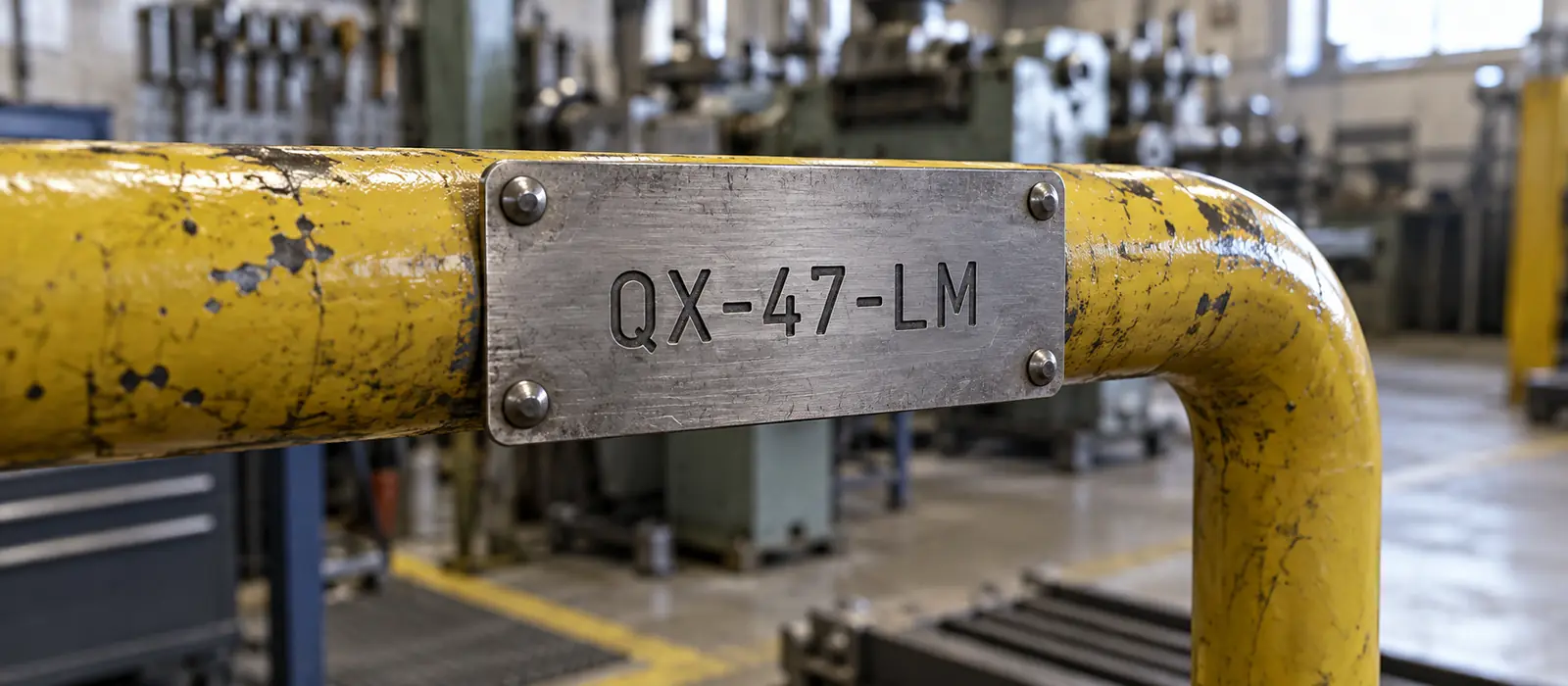
Industrial labelling answers a different question from the rest of signage. A shop fascia is trying to attract attention; a valve tag is trying to tell somebody, possibly at three in the morning and possibly under pressure, exactly which valve this is.
That single difference drives all the design decisions: unambiguous text, consistent conventions across a site, and a physical carrier that survives the environment.
Pipe and services identification
The British Standard for identifying pipelines and services is BS 1710, currently BS 1710:2014. It applies to above- and below-ground pipes, ducts and conduits, and it is the recognised way of meeting the pipe-marking expectations that sit under the safety signs regulations.
The system has two halves.
Colour-coded identification bands signal the broad category of contents at a glance — green for water, silver-grey for steam, brown for oils, yellow ochre for gases, among others — applied as bands around the pipe, with directional flow arrows.
Content labelling names what is actually in it. Contents must be identifiable by at least one of: the full name of the content, its common abbreviated name, its chemical symbol, the appropriate designated colour bands, or its British Standard 4580 number.
The reason for the belt-and-braces approach is straightforward — colour alone does not survive poor lighting or colour vision deficiency, and a name alone is not readable at distance. The two carry each other.
What gets labelled
- Valves and actuators — tag number, service, normal position.
- Electrical panels and switchgear — circuit identification, isolation points, arc flash references.
- Control panel legends — the fixed text around switches, lamps and instruments.
- Assets and equipment — plant numbers, inspection references, serial data.
- Pipes and ducts — contents, direction, hazard.
Choosing the carrier
| Environment | Sensible choice | Why |
|---|---|---|
| Indoor plant, panels, switchrooms | Engraving laminate | Colour is structural, cannot wash off, cuts cleanly |
| Outdoor, UV-exposed | Anodised aluminium | Survives sunlight; laminate fades |
| Washdown, food, chemical | Stainless steel, annealed | Passive layer stays intact under the mark |
| High-wear, abraded | Deep-engraved stainless | Depth survives handling |
The recurring failure is an adhesive label in a hot or wet environment. Tags that are tied, riveted or screwed outlive adhesive by an order of magnitude in plant conditions, and the label falling off is not a cosmetic failure — it is an unidentified valve.
Marking process notes
Where the plate is metal and the corrosion barrier matters, the choice between annealing, shallow ablation and deep engraving is a real engineering decision and is set out on laser marking metal. The short version: if the part has to stay corrosion-resistant, do not cut a groove in it.
Practical points
- Consistency beats cleverness. One abbreviation convention, one plate size family, one text height per class of label, site-wide.
- Design for the reading distance, then check it at that distance rather than on screen.
- Record the scheme. A labelling standard that lives only in the head of the person who ordered the first batch will drift within two years.
- Standards get revised. BS 1710 is linked below; use the current edition, not this page.