Statutory safety signs
The 1996 Regulations, BS EN ISO 7010 and BS 5499. What a safety sign is legally for, why it is the last control rather than the first, and which standard applies where.

A safety sign is a legal instrument with a graphic on it. Understanding what it is for explains most of the rules that surround it, including the ones that look arbitrary.
The 1996 Regulations
The Health and Safety (Safety Signs and Signals) Regulations 1996 apply to all places of work covered by the Health and Safety at Work etc Act 1974. The official guidance is HSE’s L64, aimed at employers, dutyholders and anyone responsible for the control of workplaces, sites and premises, and it also covers equipment requiring verbal or non-verbal communication.
The central principle is easy to state and constantly ignored: signs are required where, despite putting all other relevant measures in place, a significant risk remains.
A sign is not a control. It is what is left after the controls. Guarding the machine, extracting the dust, changing the process — those are controls. A sign that says “danger” on an unguarded machine has not made anybody safer, and putting one up does not discharge the duty.
Signs must be clear and legible, and they are used to identify:
- actions that are prohibited — no access;
- safeguards that must be followed — ear protection must be worn;
- warning of a hazard — corrosive material;
- direction towards fire exits, fire equipment or first-aid equipment.
Which standard applies
Two standards run alongside each other in UK workplaces, and both are accepted.
BS EN ISO 7010 is the harmonised international standard for graphical symbols, giving each safety sign a registered symbol and a reference code. Its point is that the symbol means the same thing regardless of the reader’s language. Details of ISO 7010 are included in the HSE guidance.
BS 5499 is the British Standard series. BS 5499-10 gives guidance on the selection and use of safety signs and fire safety notices; BS 5499-4 is the code of practice for escape route signing. BS 5499 covers how to select, install, position and maintain signs conforming to BS ISO 3864-1 and BS EN ISO 7010.
BS 5499 is written to satisfy the requirements of both the 1996 Regulations and the Regulatory Reform (Fire Safety) Order 2005. It applies to all premises except private domestic ones — though it does apply to the common access areas of multi-occupied dwellings, which is why a block of flats has escape signage and a house does not.
Most current signage is designed to satisfy both standards at once, which is generally the sensible specification.
Fire safety specifically
Under the 1996 Regulations and the Regulatory Reform (Fire Safety) Order 2005, the legal requirement is for adequate signage based on the premises’ fire risk assessment. There is no universal shopping list. The risk assessment determines what is adequate, and two buildings of identical size can legitimately need different signage.
The practical consequence is that copying a neighbour’s signage is not a compliance strategy.
Where engraving comes in
Prohibition, warning and mandatory signs are normally printed or manufactured to the standard symbol set, and engraving them is neither necessary nor helpful — the symbols are specified and a compliant printed sign is a compliant sign.
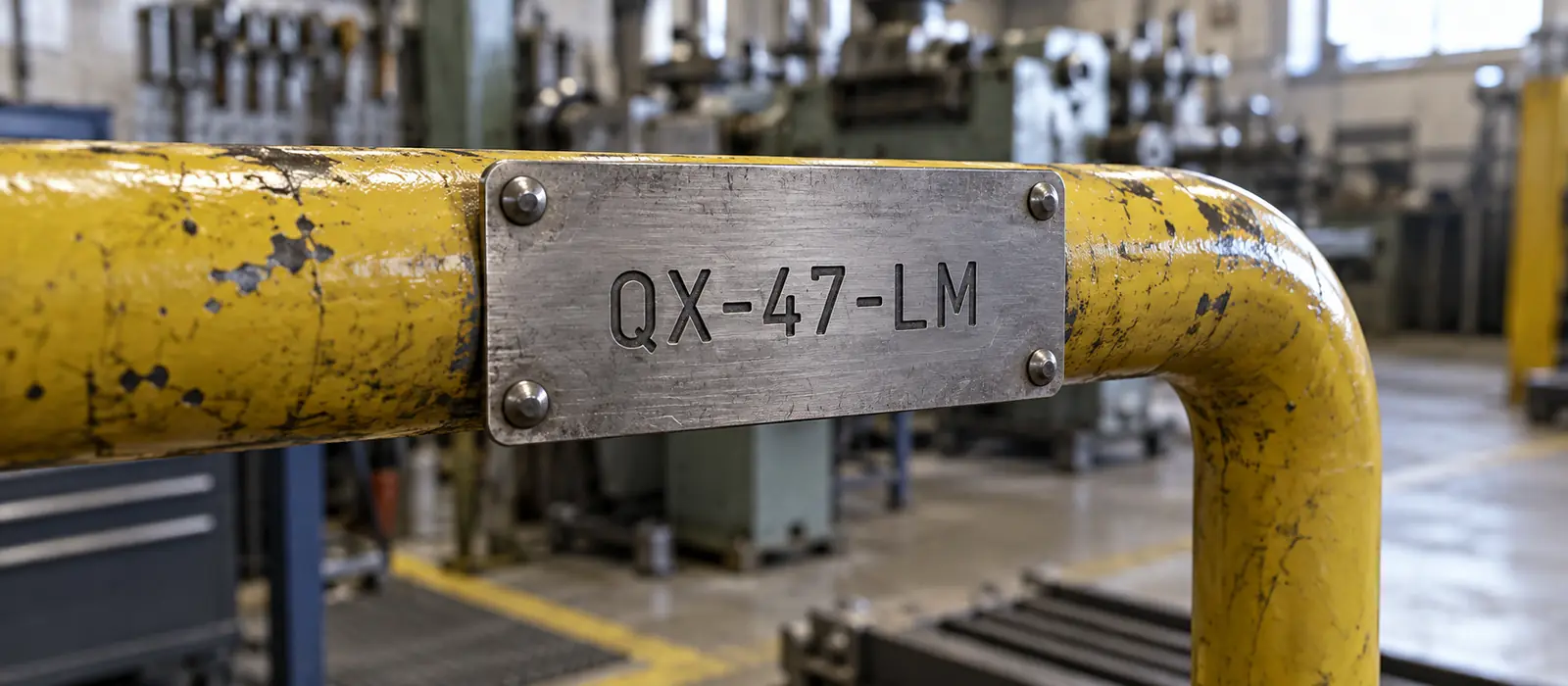
Engraved plates do the work alongside them: plant and equipment identification, isolation point labels, valve and asset tags, permit-to-work references, door and room identification. Those are the subject of industrial signage, and the usual carrier is engraving laminate, because the colour is inside the material and cannot wash off.
Practical points
- Do not mix symbol sets across a site. Two visually different fire-exit running-man symbols in one building is a legibility problem regardless of the compliance of either.
- Maintenance is part of the duty. A faded or obscured sign is not performing.
- Text under a symbol supplements it, it does not replace it. The symbol carries the meaning.
- Go to the standard, not to a summary. This page is orientation. The linked sources are the authority, and standards are revised.