Hand engraving and the graver
The oldest of the processes, and the only one that produces a bright cut. What a graver is, how the craft connects to goldsmithing and printmaking, and why it survives.
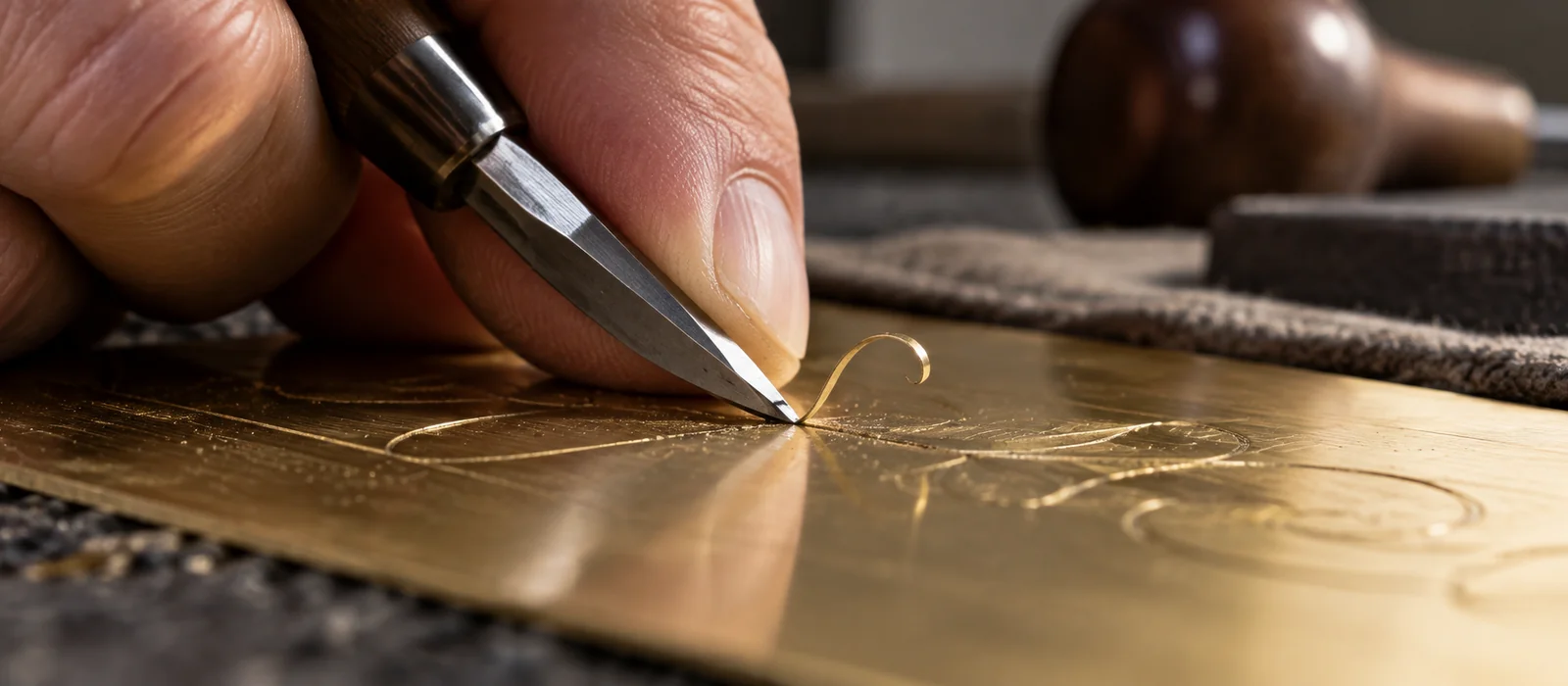
Every other process on this site is a mechanisation of this one. A hardened steel tool with a bevelled tip is pushed through metal under hand pressure, lifting a shaving out of the surface. The tool is called a graver, or by its French-derived name, a burin.
The tool
A graver is a short steel shaft ending in a bevelled, usually diamond-shaped tip, set into a rounded handle that sits in the palm. It is pushed, not dragged and not struck: the cutting force comes from the heel of the hand while the fingers steer. Gravers are ground to different face angles and profiles depending on whether the job wants a fine outline, a broad shaded stroke or a flat-bottomed channel, and the same engraver will resharpen a tool many times in a day’s work.
The material list is wide — silver, gold, steel, brass, nickel, titanium — because the tool is harder than all of them and the technique scales with the operator rather than with the machine.
Why the cut is bright
This is the thing no other process reproduces. A graver leaves a clean, faceted wall of freshly exposed metal. That facet is a mirror, so the line flashes when the piece is turned. A laser mark is thermal damage and reads matte; a rotary groove has a tool-shaped bottom and reads grey; a bright cut throws light. Bright-cut work and engine-turned grounds became central to European goldsmithing precisely because of that optical behaviour.
The goldsmith and the printmaker
The craft has two lineages that share a tool.
On the goldsmithing side, engraved decoration was standard practice in fine silver and jewellery through the fifteenth to eighteenth centuries, and the trade was regulated early: gravers and cutters of seals appear in the Goldsmiths’ Company’s first hallmarking act of 1300, ordered not to hold back an undue share of the precious metal removed during engraving. That is a striking detail — the swarf from engraving silver was valuable enough to legislate about. The regulatory thread runs unbroken to modern UK hallmarking.
On the printmaking side, the same burin was adapted to cut lines into a copper plate so the lines could hold ink. The skill appears to have come directly out of goldsmithing. The earliest engravings were produced in Germany in the 1430s, and by the 1470s the technique was being used for monumental works, by Schongauer in Germany and Mantegna in Italy. Intaglio printing — ink sitting in the incised line rather than on the raised surface — is engraving used as a matrix rather than as decoration.
Where it survives
Hand engraving is on the Heritage Crafts register as a living craft, which is a plain statement that it is still practised and still transmissible. It survives where the machine result is not acceptable: presentation silver, firearms, seal engraving, restoration and repair of engraved work, monograms and armorials, and any lettering where an experienced hand adjusts the design to the object in front of it rather than to the object the file assumed.
It also survives as the reference point. When a specification asks for a “traditional” or “bright cut” finish, it is asking for this, and no parameter change on a laser will produce it.