Laser marking metal without cutting it
Annealing, dye change and ablation mark metal while leaving the protective layer intact. On stainless steel and anodised aluminium that distinction is the whole engineering argument.
There is a class of jobs where cutting into the metal is the failure, not the goal. Anything that has to stay corrosion-resistant, stay flush, or stay hygienic wants a mark that is in the surface rather than through it.
Annealing
Annealing heats the metal locally, without vaporising it, and grows an oxide layer. The colour depends on the oxide thickness — greys, browns, blacks — and the surface stays flat and unbroken. No material is removed.
On stainless steel this matters more than it sounds. The steel’s corrosion resistance comes from a thin chromium-rich passive layer. Deep engraving cuts through it and opens a groove that traps moisture and contaminants; annealing leaves it in place. That is why annealed marks are the norm on surgical instruments, food-contact equipment and anything that gets washed down aggressively.
The trade-off is that an annealed mark is a surface effect. It is durable against corrosion and washing, but it can be polished or abraded off. Where a mark must survive genuine wear, deep engraving is the right answer and the passivation has to be restored afterwards.
Ablation and dye change
On a coated metal there are two more options.
Ablation removes the coating and shows the substrate. On black anodised aluminium, taking off the anodic layer exposes bright metal underneath, which is where the classic silver-on-black legend comes from. The contrast is excellent. The cost is that the anodic layer is the corrosion and abrasion protection, so under each letter there is now bare aluminium.
Dye change — often sold as laser etching on anodised parts — heats the anodic layer enough to bleach or alter the dye without removing the layer. The published depth difference is stark: etching of this kind affects roughly a quarter of a millimetre of surface, against several millimetres for true engraving. The layer survives, and with it the corrosion and abrasion resistance. The mark is lower in contrast than full ablation, and that is the trade.
Choosing, in one table
| Requirement | Process | What survives |
|---|---|---|
| Must not break corrosion protection | Annealing (bare metal) or dye change (anodised) | Passive / anodic layer intact |
| Maximum contrast, cosmetic part | Ablation to bare metal | Contrast; protection locally lost |
| Must survive abrasion and handling | Deep engraving | Depth; needs repassivation on stainless |
| Must be flush for hygiene or sealing | Annealing | Flat surface |
Practical notes
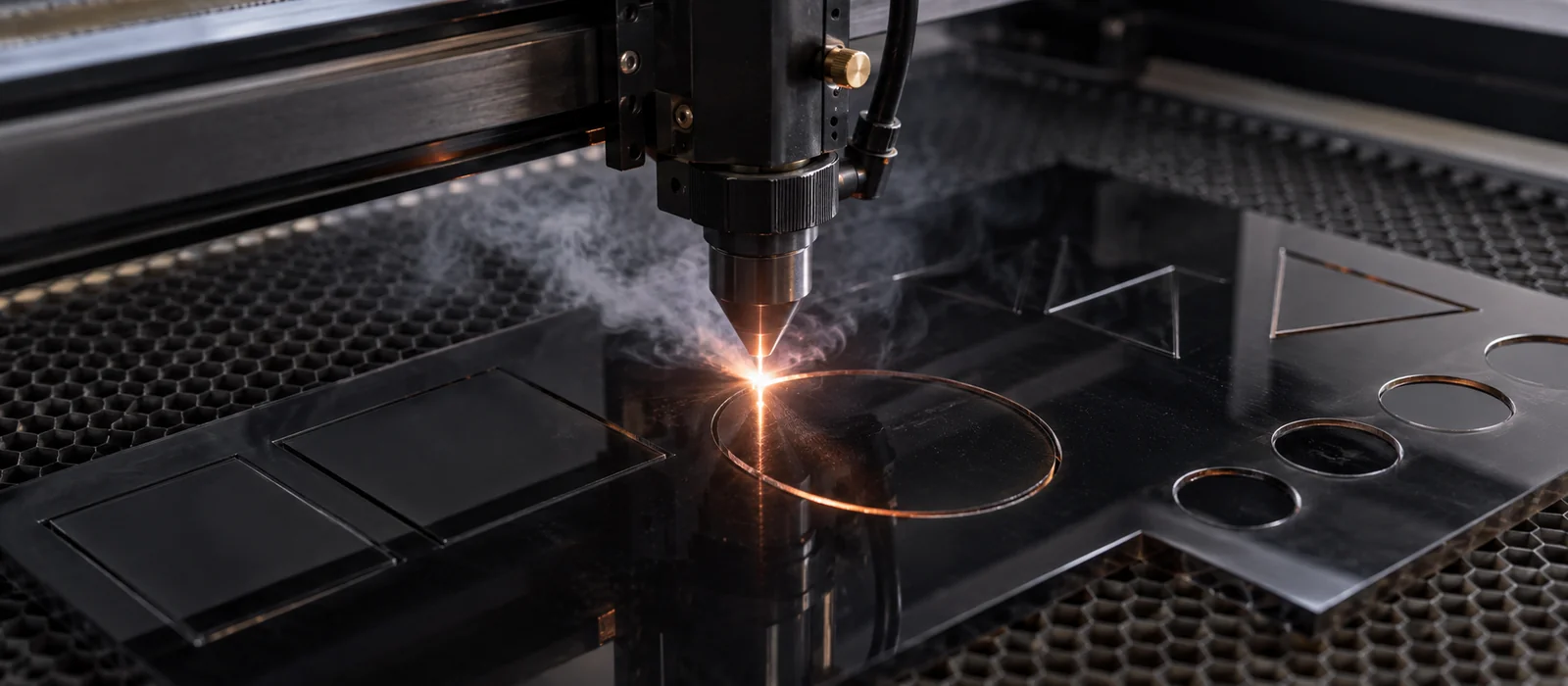
- Wavelength is not optional. Bare metal absorbs near-infrared efficiently, so this is fibre laser territory. A CO₂ machine cannot mark bare stainless at all without a marking compound applied first — what it does well is remove a powder coat, which is ablation of the coating and not a mark on the metal. The general wavelength argument is on the laser engraving page.
- Test on the actual stock. Alloy, temper, surface finish and anodising thickness all shift the parameters. A recipe that gives a clean black anneal on one batch of 316 will run brown on another.
- Decide the requirement before the process. Almost every argument about laser marking is really an unstated disagreement about whether depth or surface integrity is the priority.