Sandblasting and abrasive-blasted glass
Abrasive blasting frosts glass by eroding it through a resist. It is the deepest and most controllable way to decorate glass, and the one with a genuine occupational health problem attached.
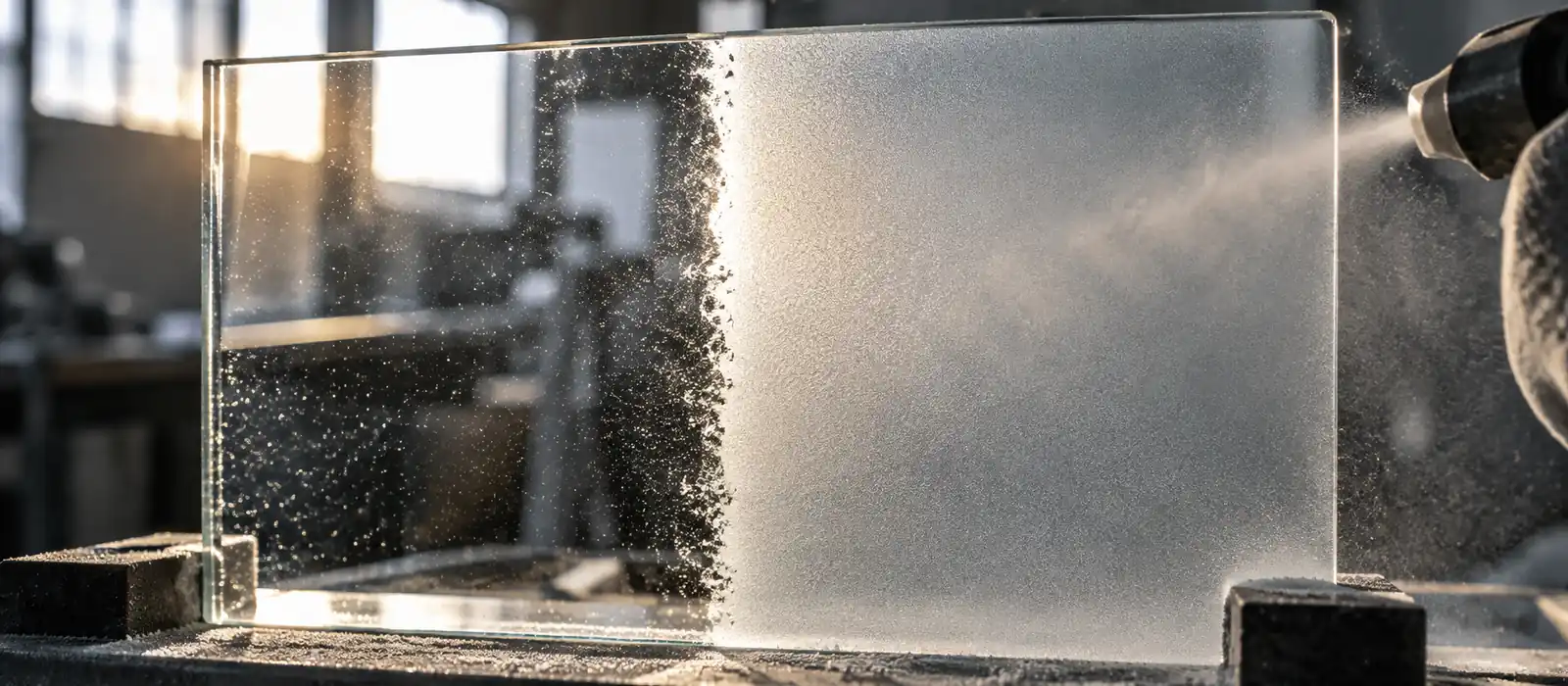
Abrasive blasting is erosion used as a drawing tool. A stream of abrasive particles is fired at the glass; wherever the surface is unprotected, the impacts fracture it into a fine white frosting. Wherever a resist covers it, nothing happens. The image is the shape of the hole in the resist.
How the process is controlled
Four variables give the operator the whole range of effect:
- The resist. A self-adhesive film or stencil is applied and cut. Everything downstream depends on how cleanly the resist is cut and how well it is stuck down, because a lifting edge lets abrasive creep underneath and the line goes soft.
- Grit size. Coarse abrasive cuts faster and leaves a rougher, whiter frost; fine abrasive leaves a smoother, greyer, more even surface.
- Pressure and dwell. Time on target converts a surface frost into real depth. This is what separates blasting from the other glass processes — you can carve down millimetres, not microns, and shape the floor of the cut.
- Stage blasting. Removing sections of resist in sequence, and blasting between removals, builds tonal depth: areas exposed for longest end up deepest and lightest.
Deep, shaded, sculptural blasting on the outside of a vessel is a recognised decorative technique in its own right, alongside wheel engraving and acid etching.
Compared with the other ways of marking glass
| Process | What it does | Depth |
|---|---|---|
| Abrasive blasting | Erodes through a resist | Surface frost to deep carving |
| Wheel engraving | Cuts with an abrasive-fed spinning copper wheel | Shallow to moderate, highly modelled |
| Diamond point | Scratches lines with a diamond | Very shallow, linear |
| Acid etching | Dissolves the surface chemically | Shallow, uniform texture |
| Laser | Fractures the surface thermally | Very shallow frost |
Acid etching uses hydrofluoric acid, often with sulphuric acid, and the finish ranges from smooth to frosted depending on glass type, acid strength and exposure. It is not a small-workshop process: hydrofluoric acid is exceptionally hazardous. Blasting gets to a comparable frosted look by mechanical means, which is one reason it displaced acid for most commercial work.
More on the substrate itself is on the glass page.
The health problem, stated plainly
Blasting glass generates airborne dust, and the dust is the hazard, not the noise.
Respirable crystalline silica is generated when materials containing silica are worked, and inhaling it causes silicosis — irreversible, and capable of continuing to progress after exposure has stopped — as well as chronic obstructive pulmonary disease and lung cancer. Abrasive blasting is named repeatedly in occupational health guidance as one of the highest-exposure activities there is.
Two points from UK guidance are worth stating on their own:
- Sand is not used as a blasting abrasive. Guidance is explicit on this, and non-silica media exist for exactly this reason. The historic name “sandblasting” outlived the practice.
- The control is isolation, not a mask. The recommended approach is to carry out blasting in a booth or segregated area with local exhaust ventilation, with a means of confirming the extraction is actually running — an airflow indicator — before work starts. Respiratory protective equipment sits on top of that, not instead of it.
Anyone reading this page as a specification should go to the guidance itself rather than to this summary. The sources below are the primary material.