Types of engraving used nowadays
What is actually in use in a working shop today: fibre and CO2 lasers, rotary and diamond drag, abrasive blasting and hand work — and which jobs each one has taken over.
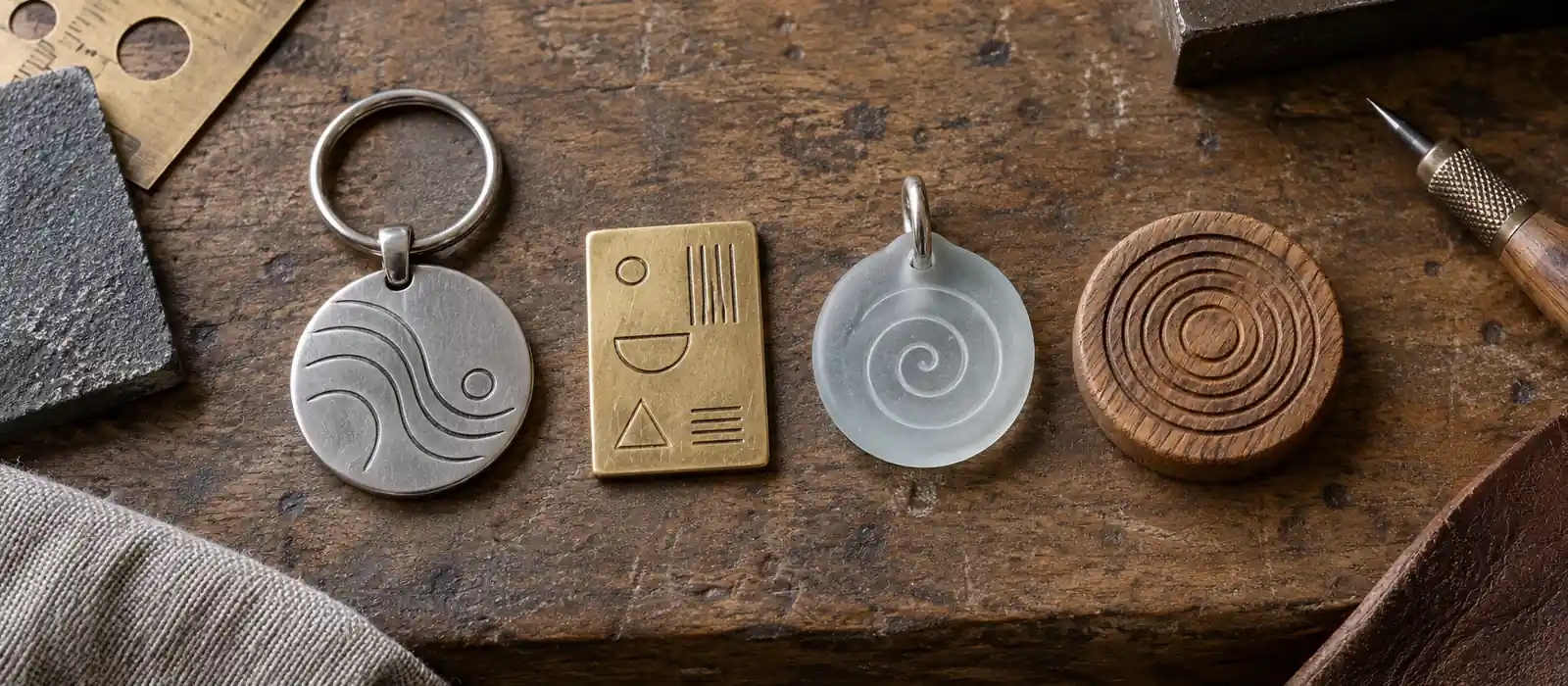
The processes in daily use have shifted a long way in twenty years, and not evenly. Some jobs moved wholesale to lasers; others never left the mechanical machines; one is doing better now than it was.
Fibre laser — the metal workhorse
Fibre lasers emit near 1064 nm, which metals absorb efficiently, and they have taken over metal marking almost completely. On one machine, by changing parameters rather than hardware, a shop can produce a surface anneal, a shallow etch or a deep engraving.
That flexibility is why fibre displaced so much: serial numbers, data plates, tool and asset marking, medical and food-contact equipment, jewellery interiors. Where the mark must not break a corrosion barrier, annealing is the reason — see laser marking metal.
CO2 laser — everything that is not bare metal
CO2 emits around 10.6 µm, absorbed well by organics and non-metals: wood, acrylic, leather, paper, glass, and coated or painted surfaces.
The limitation is categorical rather than a matter of degree. CO2 cannot mark bare stainless steel at all without a marking compound applied first. What it does superbly is remove a coating — a powder-coated tumbler engraves beautifully on CO2 because the machine is taking off the coating rather than marking the metal.
Rotary and diamond drag — not displaced
The mechanical machines kept the work lasers do badly.
Rotary still owns any job with a specified depth, engraving laminate plates, and curved or awkward workpieces that a flat laser bed cannot focus across evenly — the inside of a ring, a trophy cup, a recessed panel.
Diamond drag kept fine bright lettering on bare metal. The point does not rotate; it ploughs a hairline by displacing material rather than cutting it, so it makes almost no dust, runs fast, and gives a bright fine line that a laser’s matte burn cannot imitate.
UV laser — the specialist
UV works by breaking molecular bonds rather than by heating, which makes it the tool where heat damage is the problem: sensitive plastics, thin films, glass. Small share of the market, no substitute where it is needed.
Abrasive blasting — still the deep one on glass
Blasting is the only glass process that gets to real depth quickly, and it scales from a light frost to sculptural carving. It has a serious respirable-silica hazard attached, which is covered properly on the sandblasting glass page. It has not been displaced because nothing else does what it does.
Hand engraving — smaller, and healthier than expected
Hand work lost all the volume jobs and kept the ones that need judgement: presentation silver, seal engraving, restoration, monograms and armorials, and anything where the design is adjusted to the object rather than to the file. It is the only process producing a bright cut, and that alone guarantees it a market. See hand engraving.
What decides the choice in practice
| Question | Answer that settles it |
|---|---|
| Is the substrate bare metal? | Fibre, rotary or diamond drag. Not CO2 |
| Is a stated depth required? | Rotary, or deep fibre engraving |
| Must the corrosion barrier survive? | Annealing or dye change |
| Is the surface curved or recessed? | Rotary |
| Is it glass, and does it need depth? | Abrasive blasting |
| Does it need to sparkle? | Hand engraving |